


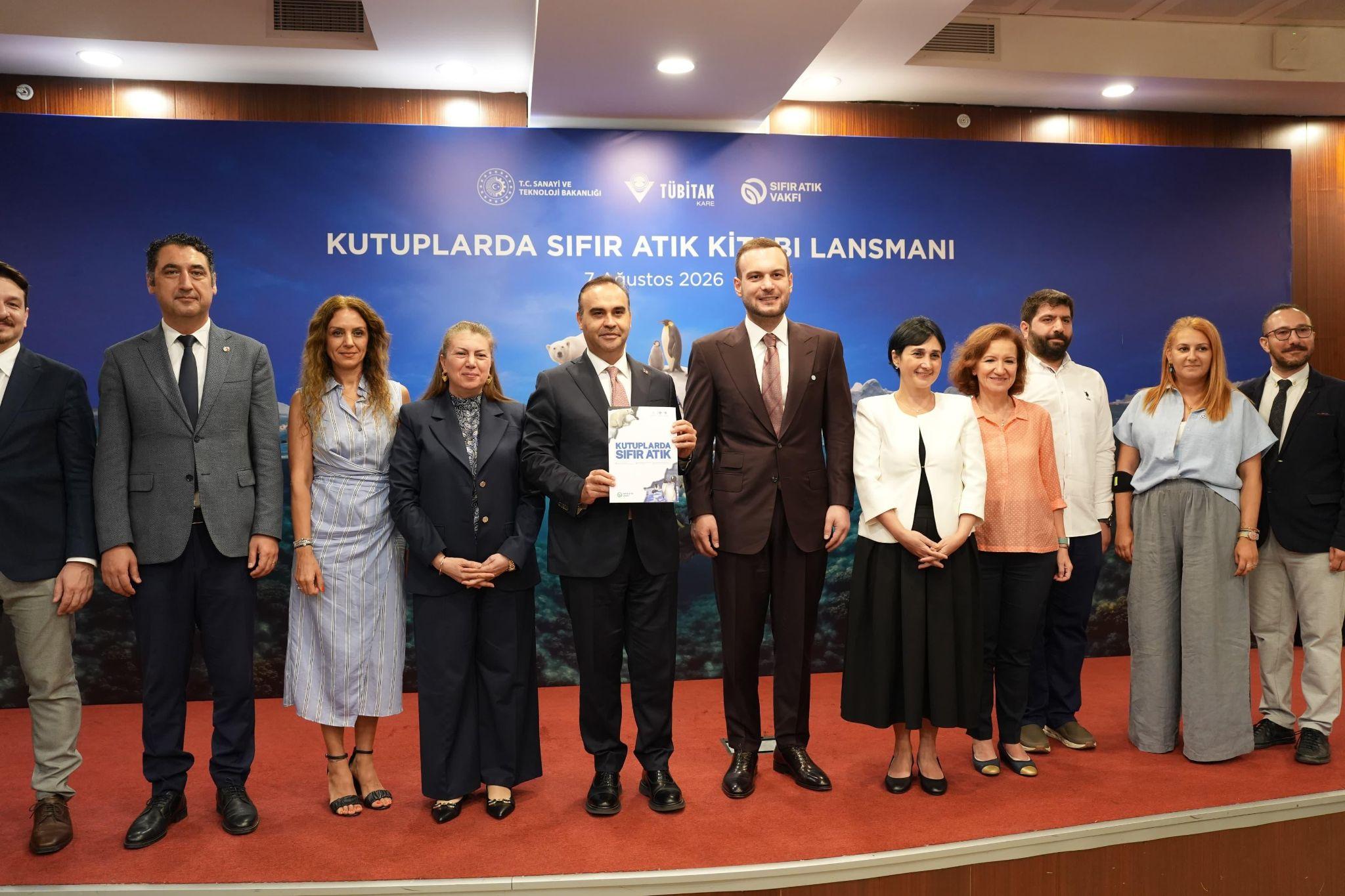
A Turkish organisation dedicated to eliminating waste has deepened its ties with London’s climate community, signing a formal partnership with London Climate Action Week just days after publishing a book examining how zero waste principles can be applied to scientific research in the Arctic and Antarctic.
The Zero Waste Foundation, based in Türkiye, agreed the cooperation protocol with London Climate Action Week (LCAW) on 17 August, ten days after launching “Zero Waste in the Polar Regions”, a book produced with the Polar Research Institute of TÜBİTAK, Türkiye’s Scientific and Technological Research Council. Both developments are being presented as part of Türkiye’s build-up to hosting COP31, the next major United Nations climate conference.
The London agreement is the more immediately significant element for a UK audience, since it formally links a Turkish environmental body with LCAW’s network of government, business, finance, academic and civil society actors who gather in the capital each year to discuss climate policy and action. The protocol was signed by Samed Ağırbaş, President of the Zero Waste Foundation and a COP31 High-Level Climate Champion, and Nick Henry, founder and chief executive of Climate Action.
“After this cooperation protocol, I hope we will carry out strong work and organize joint events at COP31 and London Climate Action Week,” Ağırbaş said.
The agreement covers climate action, zero waste and circular economy approaches, and is intended to strengthen knowledge exchange and joint initiatives between the two organisations. According to the Foundation, the deal gives Türkiye’s experience in zero waste and circular economy work a direct route into London’s international climate ecosystem, with COP31 providing the wider diplomatic backdrop against which that cooperation will play out.
A book that takes zero waste to the poles
The London partnership follows closely on the publication of “Zero Waste in the Polar Regions” on 7 August, a book that applies the zero waste concept to one of the most remote and scientifically sensitive environments on Earth. Produced jointly by the Zero Waste Foundation and the Polar Research Institute of TÜBİTAK, it draws on 18 articles written by scientists who have taken part in polar research expeditions, covering the scientific, technical, administrative and communication aspects of applying zero waste principles in the Arctic and Antarctic.
Rather than focusing narrowly on waste collection, the book examines how scientific expeditions are planned, how materials and resources are used in the field, and how energy, water and logistics are managed throughout research activity. The underlying emphasis is on preventing waste before it is created, using resources efficiently, and reducing the overall environmental footprint of scientific work carried out in polar conditions.
The publication frames the polar regions as key indicators of global climate change, arguing that environmental shifts recorded there carry consequences that extend well beyond the Arctic and Antarctic themselves. That framing is intended to give the research a relevance that reaches far beyond the specific locations in which it was conducted.
Mehmet Fatih Kacır, Türkiye’s Minister of Industry and Technology, said the book brought together two initiatives that both began in 2017. “The Zero Waste initiative launched under the leadership of H.E. Emine Erdoğan has grown step by step from a national initiative into a global one,” he said.
He added: “At the same time, we began organising scientific expeditions to Antarctica and the Arctic under the auspices of the President of the Republic of Türkiye, enabling Turkish scientists to strengthen the country’s presence in polar research. Through this book, these two initiatives have come together.”
The study also draws on the broader zero waste vision associated with H.E. Emine Erdoğan, who founded the Zero Waste Movement, chairs the UN High-Level Advisory Board on Zero Waste, and serves as Honorary President of the Zero Waste Foundation.
Setting the stage for COP31
Together, the book and the London protocol are being positioned by the Foundation as complementary steps in the same broader strategy: connecting Türkiye’s domestic environmental initiatives with international climate diplomacy ahead of COP31, which Türkiye is due to host.
London Climate Action Week itself brings together representatives from government, cities, business, finance, academia, civil society and local communities, making it a significant point of international engagement for organisations seeking to build climate partnerships. By formalising its relationship with LCAW, the Zero Waste Foundation gains a direct channel into that network, while COP31 supplies the wider context in which the collaboration is expected to develop further.
For now, the Foundation says its immediate focus is on practical exchange with the LCAW network rather than on large-scale announcements, with joint events at COP31 and future editions of London Climate Action Week described as a hoped-for next step. The organisation has been at pains to stress that its work should not be understood simply in terms of recycling or waste management. Instead, it presents zero waste as a framework that spans scientific research, resource efficiency and circular economy thinking, applied here to environments as far removed from everyday life as the polar regions, and now extended into the heart of London’s climate policy conversations.
The two developments, a scientific publication grounded in polar fieldwork and a formal partnership with one of London’s leading climate platforms, illustrate how Türkiye is seeking to link technical environmental research with international diplomatic engagement in the months before it takes on the hosting responsibilities for COP31.
